Portraits in a Cowshed


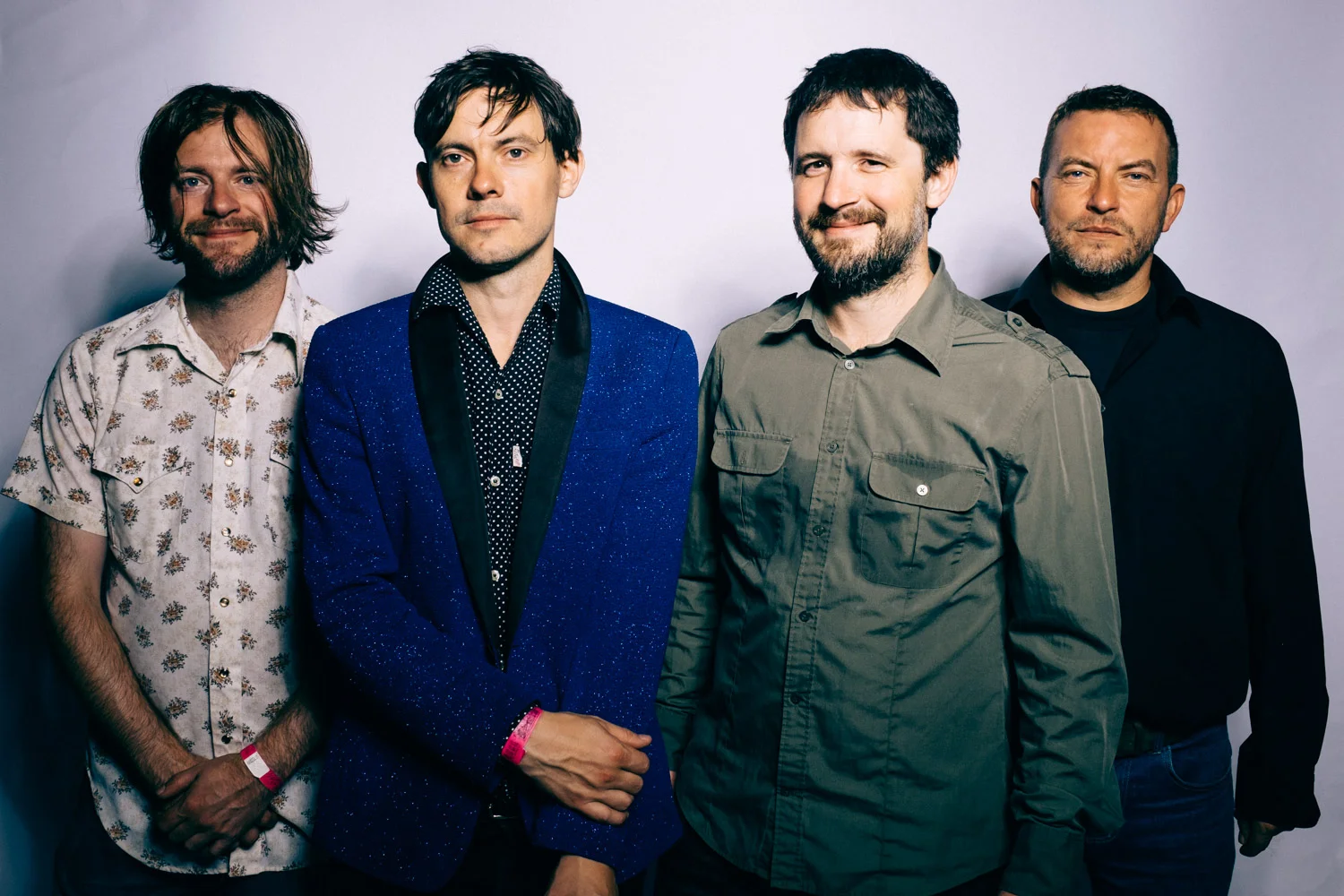
July 2017 and the Dreaming Spires have just finished their set on the main stage at Truck Festival, set on a large farm in Oxfordshire. On their way back to their recording studio located in one of the farm outbuildings, the band took a little time out to pose for some portraits in a makeshift space I created next to the studio.
Shot with Fuji XT1 XF16-55 F2.8R
Women in Music
In a recent Americana album review of 2017, a magazine cited that the majority of the Editor’s favourite albums of the year were made by women. This supports a growing trend which is encouraging and also backs up Steve Earle’s statement in a recent Guardian interview, in which he said “The best stuff coming out of Nashville is made by women”.
In a recent Americana album review of 2017, a magazine cited that the majority of the Editor’s favourite albums of the year were made by women. This supports a growing trend which is encouraging and also backs up Steve Earle’s statement in a recent Guardian interview, in which he said “The best stuff coming out of Nashville is made by women”.
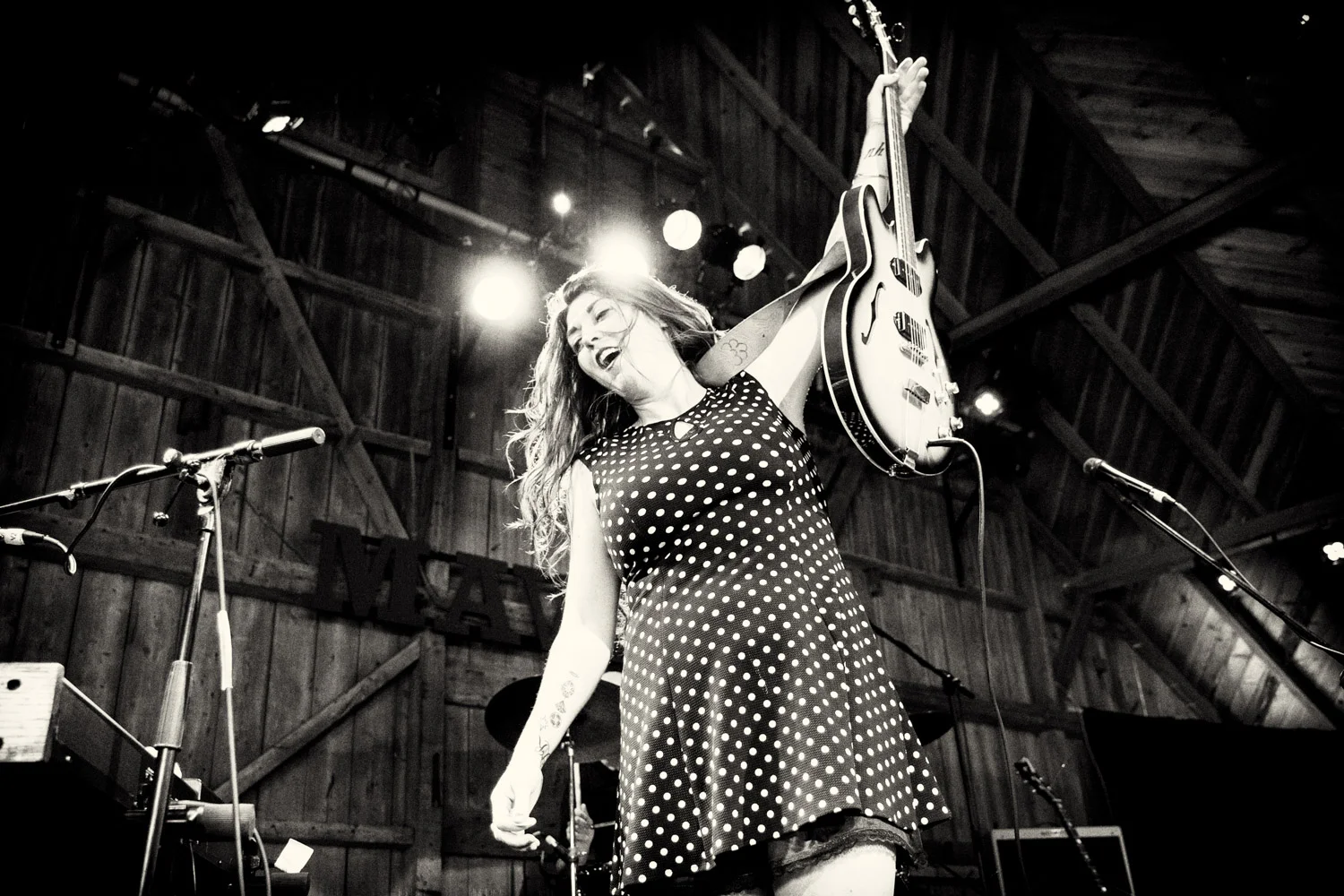
Over the past couple of years I’ve really enjoyed watching and photographing an increasing number of female music artists and the bands they front. Here are eighteen of my favourites (in alphabetical order):
- Hannah Aldridge
- Jane Allison
- Emily Breeze - Candy Darling
- Yola Carter
- Hannah Elton-Wall - The Redlands Palomino Company
- Lilly Hiatt
- Victoria Klewin
- Rachel Laven
- Terra Lightfoot
- Roisin McNeill - Newton Country
- Danni Nicholls
- Vanessa Niemann - Gal Holiday and the Honky Tonk Revue
- Erin Rae - Erin Rae & the Meanwhiles
- Rebecca Riedtmann
- Hannah Rose Platt
- Rebecca Rosewell - The Rosellys
- Joana Serrat
- Michelle Stodart


Camera: Fuji XT1 | Lens: XF16-55mm F2.8 R
Traditional Photographic and Printing Processes
Traditional photographic printing processes such as cyanotypes, daguerreotypes, tintypes and other wet plate methods have always interested me. It's partly due to the history behind the methods but also the look and feel of the finished artwork, and of course the art, craft and effort that goes into each masterpiece. Each image is a unique one-off.
Traditional photographic and printing processes such as cyanotypes, daguerreotypes, tintypes and other wet plate methods have always interested me. It's partly due to the history behind the methods but also the look and feel of the finished artwork, and of course the art, craft and effort that goes into each masterpiece. Each image is a unique one-off.
Nowadays, the digital brigade has gotten in on the act and there are software analogue emulators that will do some of the heavy lifting work for the avid photographer who wants to try these techniques out without the huge investment in learning and the specialised equipment. This is convenient but loses so much of ethos and magic which makes the traditional methods much more appealing to me.
Having said that, I'm here in Nashville to shoot a music festival with an assortment of 35mm cameras (digital and film), an instant film camera and an iPhone with an app on it called Hipstamatic. And, you guessed it, this app has some emulators for mimicking C-Type and D-Type plate film and lenses.
So, one of my side projects for the trip is to try it out and get some portraits of the artists that I get to work with while I'm here. I'll put together a wee montage of images on my return.
An artist I admire greatly who works with the traditional methods is Emil Ryge. Emil uses Wet Plate Collodion and he made a fantastic image of Andy Washington who is a very familiar character in the music circles that I mix in. Emil and Andy have given me permission to use the image to illustrate the method and the results that can be achieved using the traditional analogue method.
Andy Washington - Wet Plate Collodion by Emil Ryge
You can see more of Emil's work by clicking here.
Digital methods are no competition for the analogue methods and one day soon I will try out the traditional method. In the meantime, I'm gonna be lazy and use the app.
Americanafest 2016 - Nashville
About five years ago the people behind the highly entertaining Channel 4 TV series - The Black Cab Sessions, made an offshoot tv show which travelled to the USA to visit several cities that have had a significant impact on modern music. The producers shipped out a London black cab and crew, and drove around the country visiting these cities, picking up notable musical talent along the way for interviews and sessions in the back of the cab. It was a novel idea and made for good informative entertainment.



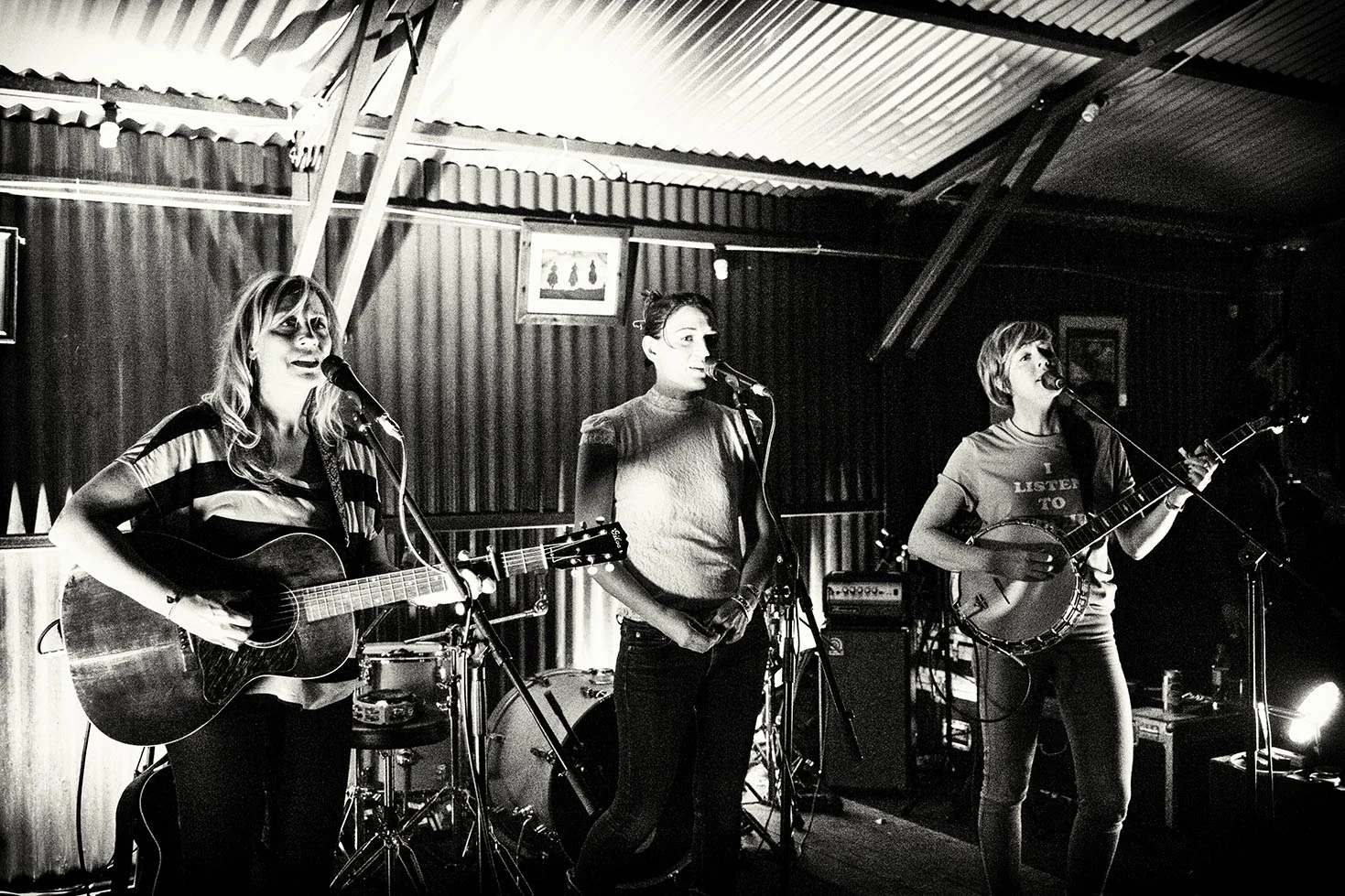


About five years ago the people behind the highly entertaining Channel 4 TV series - The Black Cab Sessions, made an offshoot tv show which travelled to the USA to visit several cities that have had a significant impact on modern music. The producers shipped out a London black cab and crew, and drove around the country visiting these cities, picking up notable musical talent along the way for interviews and sessions in the back of the cab. It was a novel idea and made for good informative entertainment.
The whole series was enjoyable, but the episode that caught my attention was the one about Nashville (watch it here: https://vimeo.com/23215543). And it wasn't for the obvious reason that I like country rock n roll music. No, it was because of the blossoming independent music scene that was developing there. It was a scene where both young and old musicians were turning their back on the city's huge corporate enterprises that dominate the entire country music business, and going alone. I was impressed.
The programme makers illustrated how this was intrinsically linked to one of their newest high profile residents - Jack White, who had decided to settle there and continue to build his own musical empire - Third Man Records.
I liked what I saw and what I heard, and decided to include Nashville in my plan, which was a solo road trip and musical pilgrimage to the southern states, an area of the USA which has driven my musical tastes for the past ten years or so. The road trip took place in Autumn 2013 and is the subject of a different story. Suffice to say, Nashville lived up to its premise and I had a great time there.
Now, three years later, I have another trip planned to Nashville next week, but this time it's a very different situation. I've been commissioned by Country Music People UK Magazine (http://www.cmpcountry.com), to photograph various events and artists at Americanafest 2016. Americanafest is a huge event organised by the Americana Music Association. The festival includes five days of gigs all across the city and also workshops and conference events. That's not forgetting the 15th Annual Honours and Awards ceremony which is held at the famous Ryman Auditorium and hosted by Jim Lauderdale.
For Country Music People, I will be working with Janet Aspley who as well as being a fine journalist is also a successful bespoke garment maker and makes shirts for stars of the Americana music scene both in the States and the UK. Check out Janet's work on her web site here: https://dandyandrose.com
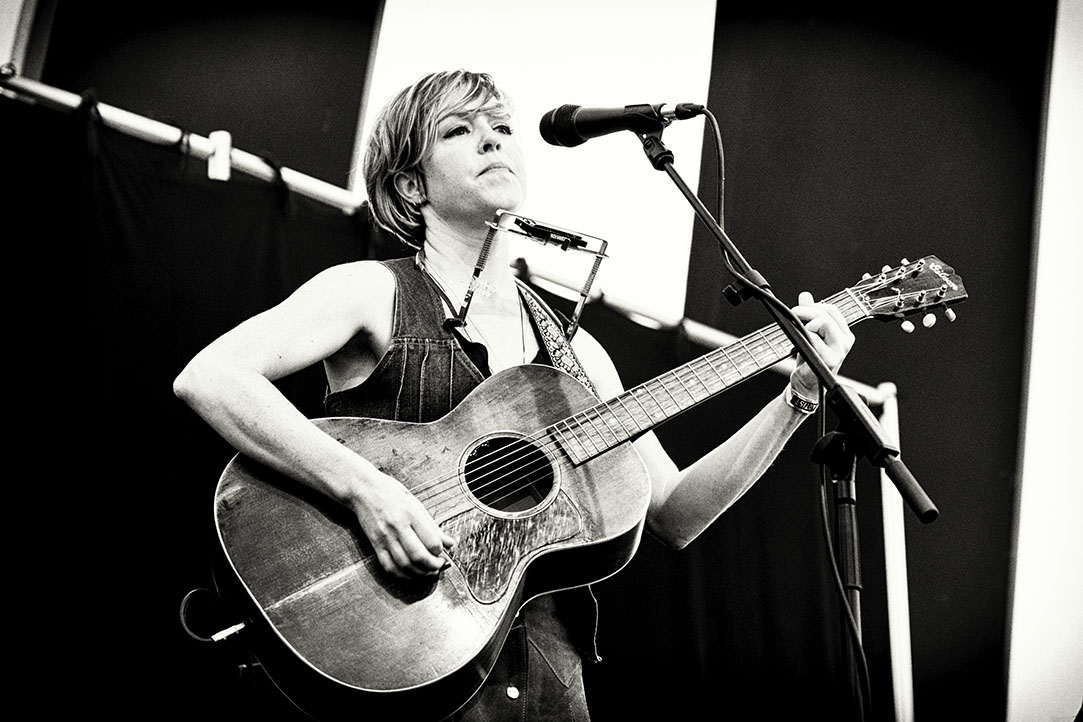
Since Nashville 2013 my music photography 'hobby' has developed (pardon the pun), into a real job. As part of this job I have had the opportunity to photograph some of the UK and international artists that will be appearing at Americanafest 2016. I am intending to catch up with them over there as well as attending many other shows and gigs along the way.
What follows is a small collection of my photos of some of the artists that will be performing in Nashville at Americanafest 2016. Maybe I'll see you there......
A Southern Gothic tale
It was a pretty scene and one I thought worthy of exploring and taking a few photographs. So I reversed the car and parked it at the side of the road nearby some tracks that lead to a deserted farm outbuilding. There wasn't a soul about but the birds were singing aptly around me despite the large birds of prey that I saw frequently high in the sky.
Nashville to Memphis is 257 miles and takes over 4 hours to drive on interstate 40 without any stops. I did this journey in 2013 as part of a longer solo road trip that started in Nashville and ended 4 weeks later in New Orleans. This particular leg of the trip between Nashville and Memphis was notable for one particular incident that has stuck in my mind ever since and can be linked perhaps to my increasing interest in southern gothic.
After a couple of hours on the road out of Nashville, I started seeing signposts for Kentucky lake. I knew nothing of this place at the time, having never heard of it. But it was called Kentucky, which spiked my interest straight away. What a nice surprise to be near a lake called Kentucky while I was in Tennessee I thought. I read later that Kentucky lake is the largest manmade lake in the eastern United States and almost stretches across the whole width of Tennessee.
Eventually I crossed a wide road bridge on the I40, which gave me a glimpse of the size of this huge waterway that stretched far northwards into the distance. On the other side of the bridge I started seeing signposts for a tourist park and sightseeing location, and I decided to take a little detour to get what I hoped was a lakeside view.
As soon as I got off the main interstate, the road became a lot quieter and I got a sense of remoteness pretty soon after leaving the freeway. There were no obvious signs saying how far my destination was, so I kept driving. The road was called Birdsong road, which was very comforting, but above my moving car I could see large raptors, of a type I could only guess at, circling in the clear, blue, early afternoon sky.
Despite these things, I was having a good time. It was a lovely warm day, I had some nice music to accompany me, and I estimated I was about halfway to Memphis with still plenty of daylight hours ahead of me. Every now and then I'd see a few shacks at the side of the road amid the trees. Some of them were a bit rundown but as I drove on the quality of the various dwellings I encountered started to improve which gave me more comfort.
However, after ten miles or so I started to get a bit weary that what first had seemed like a minor detour was turning into a longer excursion, and I started to think about turning back to the interstate. As is normally the case when having these type of doubts, things changed abruptly. The geography transformed and around me I saw holiday homes with motor boats and RVs parked alongside, but not a person in sight. I was getting closer to my end point. And then suddenly to my left a flash of bright red against brilliant blue caught my eye and I slowed the car before coming to a stop.
What I saw was a small white boarded chapel with a sharply pitched roof and steeple, which were both the colour of blood red set back from the road about 100 yards away. A well tended patch of lawn stretched up to the chapel and in the centre of the field stood a small cluster of tightly packed gravestones.
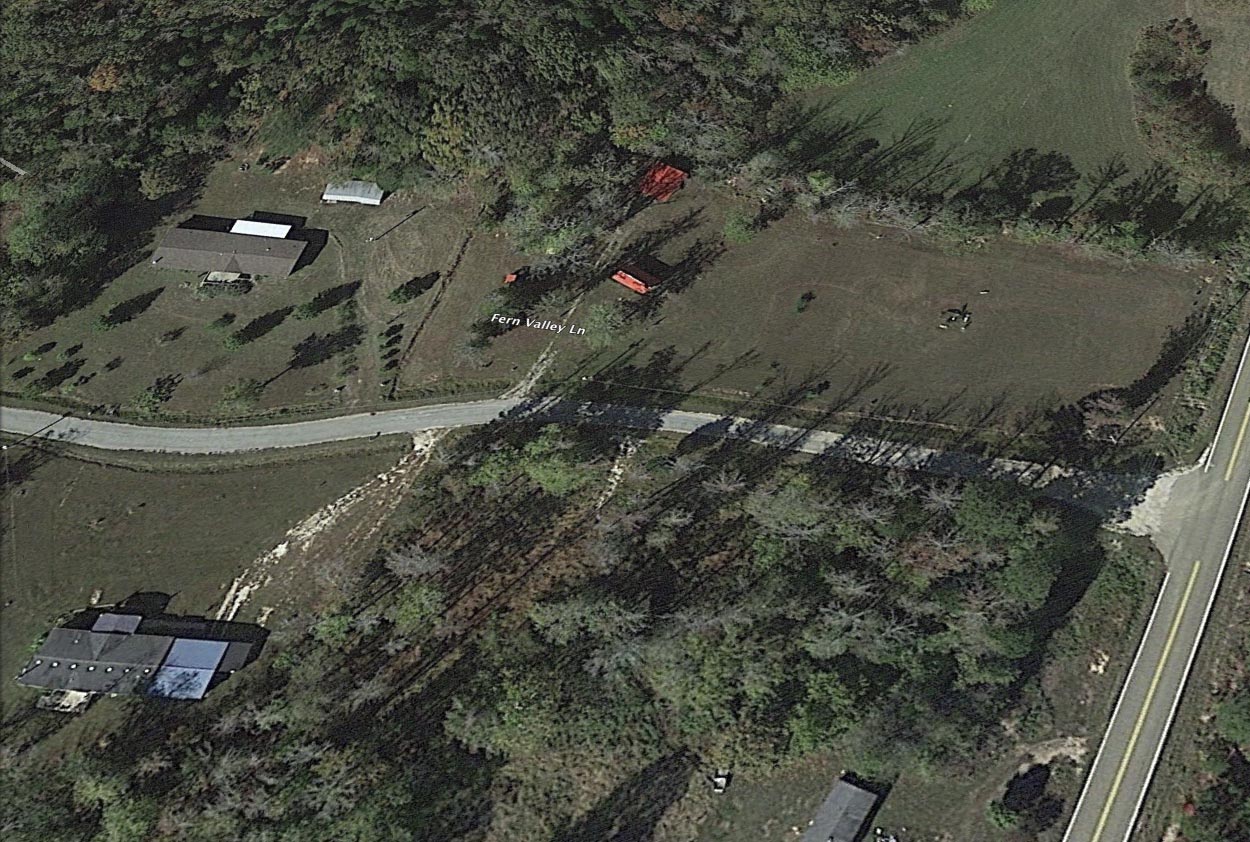
Google Maps aerial view of the Davis Park chapel and its cemetery on the junction of Fern Valley Road and Birdsong Road. The small cluster of gravestones can be seen in the field to the right of the chapel.
It was a pretty scene and one I thought worthy of exploring and taking a few photographs. So I reversed the car and parked it at the side of the road nearby some tracks that lead to a deserted farm outbuilding. There wasn't a soul about but the birds were singing aptly around me despite the large birds of prey that I saw frequently high in the sky.

The pretty chapel
The entrance to the chapel and cemetery was marked by two small statues of the Virgin Mary. I thought it best to walk between the statues rather than taking the more direct route through a patch of daisies and wildflowers. To the side of the entrance was a sign staked into the ground stating 'Davis Park', which I presumed was the name of the family either buried here or owning the land, or perhaps both.
The chapel was beautifully maintained and the white walls and red roof made it stand out from the trees and bright blue sky. It was a captivating scene, and I walked between two trees to get a closer look. I still saw nobody around but thought nothing of it. It was a beautiful, peaceful place.
I had walked about 15 feet away from the two trees when the silence was broken by a loud rustling behind me. I turned abruptly but saw nothing. The rustling got louder and then I saw movement in one of the trees. My first thought was it was one of the many large birds I had seen on my way here. I concluded that it was landing in the tree to roost and it was making a bit of a commotion at the same time.
I stood there watching the tree branches shaking and rustling as something moved between them and then suddenly something large fell to the earth with a thud in the gap between the trees.

I was totally transfixed. What appeared before me was a 6ft, twin tined, barbed tree branch that had fallen with such force that it had impaled itself into ground that I had crossed only several seconds before. The fork-shaped branch stood there defiantly with its tines pointing skyward, stuck in the soil for what seemed like an age, while I looked at it dumbfounded. Eventually it toppled backwards. I snapped out of my trance and reached for my camera to take a shot of this strange occurrence.
It took me a little while to compose myself as my imagination ran wild.
I quickly turned my back on the pretty, little red and while chapel and hastened back to the relative safety of the car, before scooting off in search of the lake and what I hoped was some human contact.