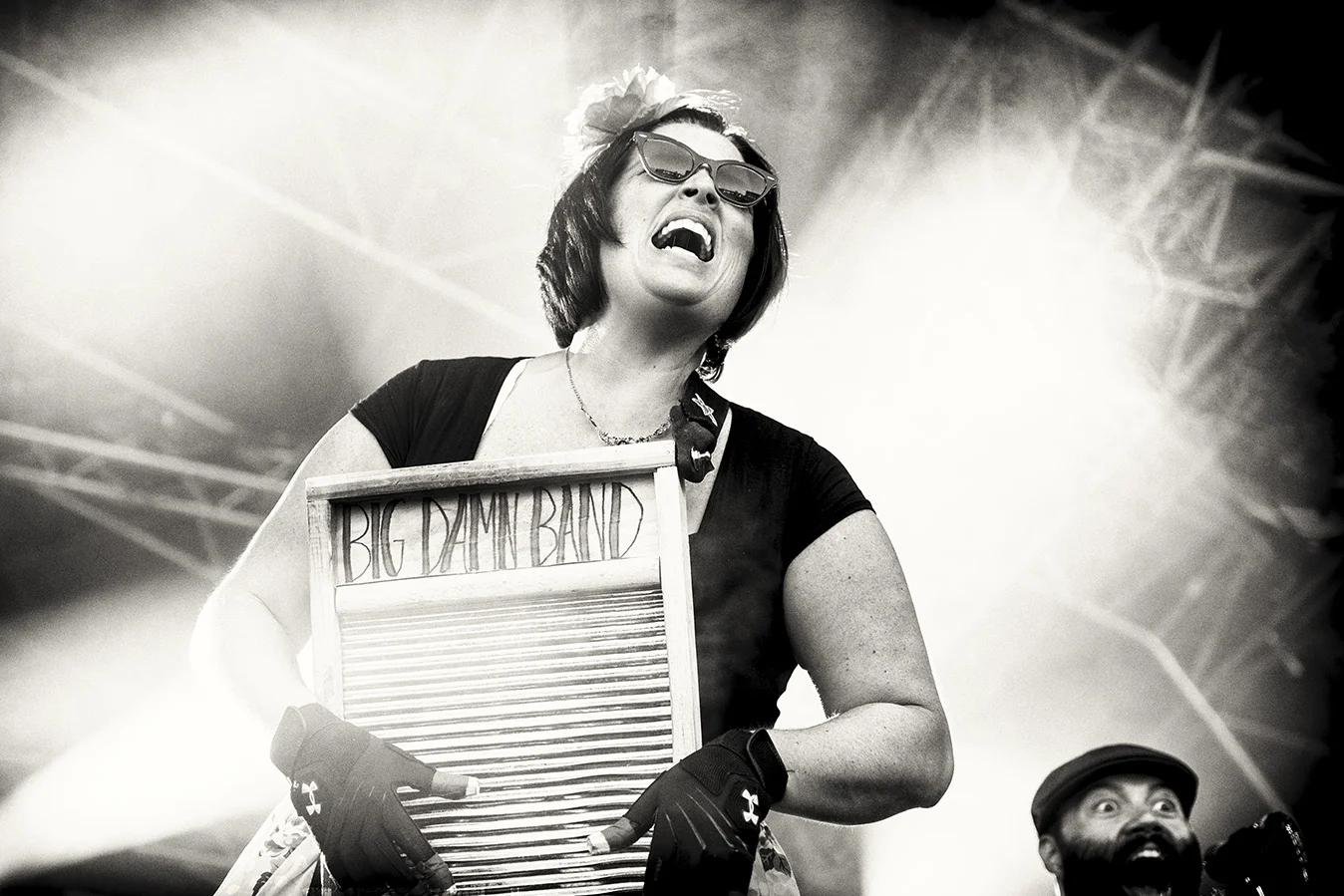
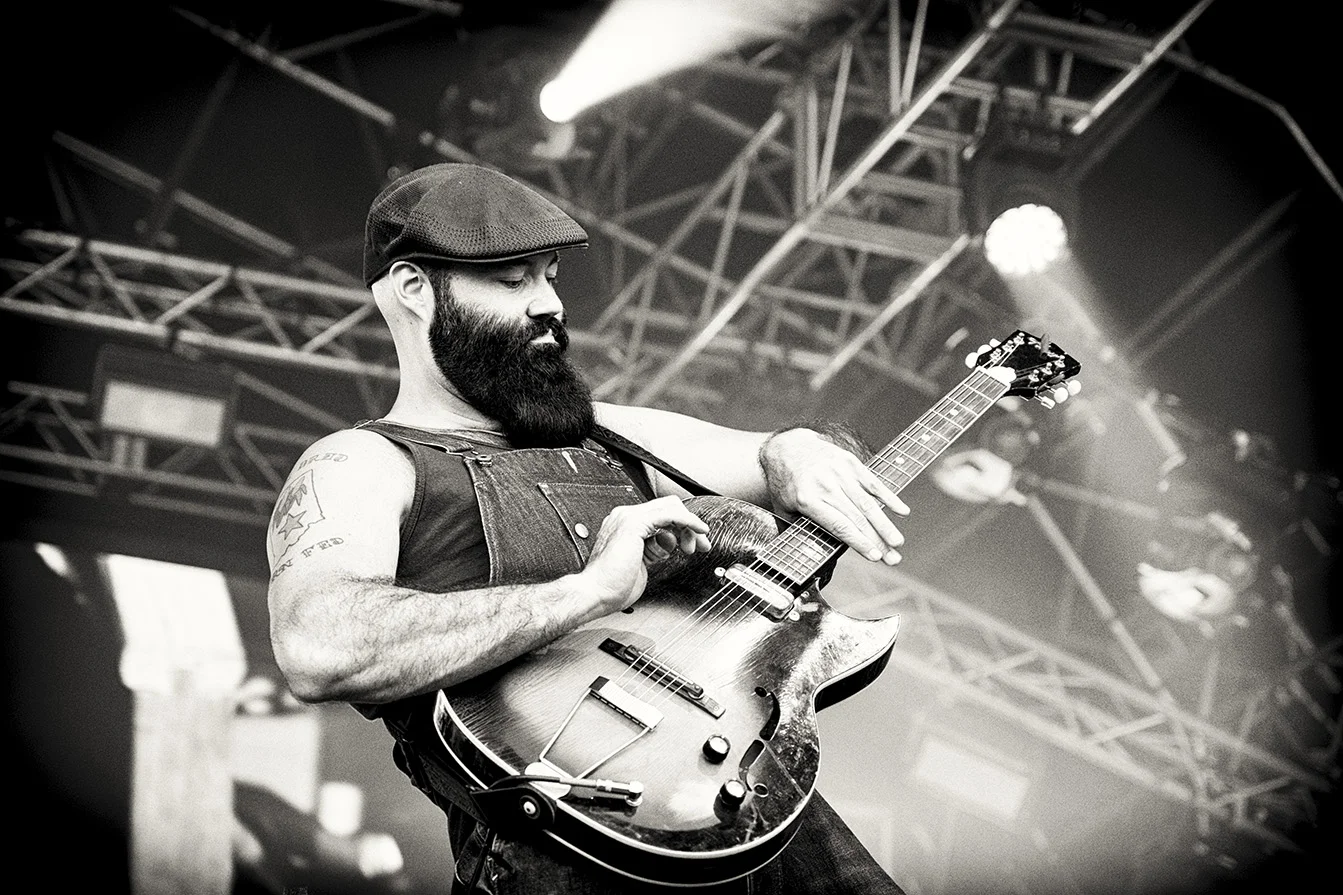
My new favourite band - Reverend Peyton and his Big Damn Band
There's a lot of energy in their songs and they sound like they're having a lot of fun making the music. The antics from the band on stage on Saturday paid testimony to that.
OK so I'm prone to say this pretty much once a month. It's a consequence of a curious mind. For an avid listener of music I've always got my ears (and eyes) open for a new band that interest me both from an audible and visual perspective.
Ready for the stage
The Grillstock festival in Bristol at the weekend introduced me to a new band that ticked both those boxes. Reverend Peyton and his big Damn Band hail from Brown County, Indiana. I subsequently stuffed their last two albums in my ears when I got home and I love them. The music is raw and direct and appeals to my love of delta blues and old time American music.
Breezy and the Reverend
There's a lot of energy in their songs and they sound like they're having a lot of fun making the music. The antics from the band on stage on Saturday paid testimony to that.
I'm hoping to catch them again over the summer in the UK. Do yourself a favour and stick their music in your ears too, or better still go see em.
The 100 Different Band Milestone
In May I reached the grand total of 100 different bands when I photographed Yola Carter at the Thunderbolt on a very memorable night that also included a great set by another new band to me - Newton Country from Bath.
Statistics sometimes interest me. I don't go out of my way to note this stuff generally, but someone asked me how many bands I've shot so I did a bit of a count up on my computer.
I’ve been involved in music photography since about 2012. Some of my first photographs were taken on film. They were of Henry Slim, John Fairhurst and Joseph Strouser at the Left Bank, and a great wee ale and folk festival at the Kingsdown Wine Vaults when Philo Sinnett ran it back in the good old days.
In May I reached the grand total of 100 different bands when I photographed Yola Carter at the Thunderbolt on a very memorable night that also included a great set by another new band to me - Newton Country from Bath.
The tally has since risen to 113.
For anyone interested in which band I have photographed most of all, that remains a close contest between the Montgomerys and John Fairhurst (solo and band). I might even put up a list of all the bands I've photographed to date at some point soon.
Yola Carter playing at the Thunderbolt in Bristol - May 2016
The Cajon drum and the origin of the name - Johnny Cajon
People often ask me where the name Johnny Cajon came from. They say to me "So where does the name Johnny Cajon come from?" And this is what I tell them.
When I was a liddle biddy boy, my grandmother gave me a cute little toy. Silver bells hanging on a string, she told me it was my ding a ling a ling.
Actually, that's not what I tell them but it gave me an excuse to quote the great Chuck Berry - This was one of the first songs I remember hearing and singing along to.
For quite some time I've been interested in, and playing, various types of hand drums. I started on Djembe when I lived in Scotland and then continued when I moved to Bristol playing in various drum circles. I then moved onto playing congas and bongos when I became interested in Latin grooves. I love all those Afro Latin rhythms and I get a big kick out of the basic connection between the hands and a resonant surface, more so than with drum sticks.
Eventually, I moved onto playing a drum kit and it was when I was taking drumming lessons at Drumbank in Bristol that I got sight of my first cajon.
My cajon and one of my self-built 4 string guitars
At that time I had really gotten into rudimentary musical instruments and I had started to make my own 3 and 4 string guitars from basic cigar boxes and kits I bought in America and online. And here was the cajon, a rudimentary percussion instrument in the simple shape of a box.
I'm really into understanding how some musical instruments and styles of music have developed from a basic need for expression, and the use of simple materials, and how they have evolved into what we now take for granted and pay hundreds of pounds for, and sometimes even more. A lot of the historical stories associated with western roots music and the instruments on which it is played like the guitar and drum are born from hardship and tough times, normally slavery involving the African slaves who were exploited in the cotton, tobacco and sugar trades between Europe, Africa and the Americas.
In the case of the cajon, the story goes that the refined instruments that we see today evolved from the humble storage boxes that were used to transport the trade goods across the oceans to South America in those grim, hard days. The word cajon is a Spanish word that means 'crate'.
Without their normal drums, the African slaves took to improvising with what they could find. They would gather around these ordinary boxes and bang away their familiar rhythms. It wasn't long before the slaves' 'owners' banished these drums as they were considered a method used for, literally, drumming up support and communicating antagonism and hatred for their oppressors. This is said to be the beginning of the cajon drum.
2 string diddley bows in a market stall in Helena, Arkansas
After reading about the history of the cajon drum and also stringed instruments like the cigar box guitar and diddley bow, which share similar origins, the various quotes and myths about great art only coming from great pain and suffering made more sense to me. The people who played these early instruments despite the circumstances in which they found themselves could not have known what would become of these humble objects. They were just satisfying an urge inside and finding tools that they could use to express themselves and tell their stories through the natural basic human communication of song and dance.
The modern cajon is a much more refined version of it's humble beginnings. It has a sound hole in the back into which you can fit a mic pickup to boost the bass tones. It has a false, and sometimes decorated, front panel (like mine above), which you hit with your fingers on the corners of the box and your full hand in the centre. Behind the front panel, on the inside of the drum are horizontal snare wires. These wires rattle and buzz when the drum is hit on the corners.
There are three key tones , or notes, on the drum. You can hit the corners of the drum with the fingers to get a snare-drum-like tone, or you can lightly tap the corners with the finger tips to play ghost notes. Using a cupped full hand in the centre of the drum gives a rich, full tone like a bass kick drum.
The modern drum is very versatile as it can be played in an acoustic setting or mic'd and amped up for more volume. Sometimes you see them being played by guitarists like John Fairhurst who sit on them and use a standard kick drum beater to give a percussion voice to their acoustic sets.
It wasn't long before I bought my first cajon. I started playing it at the same time that I started taking photographs of local musicians in Bristol. One of the key players in my world at the time, who I photographed regularly, was a brilliant young witty harmonica player called Henry Slim who continues to be one of the hardest working and most authentic musicians I know. Henry invited me along to play my cajon at a couple of his acoustic sets at the time. In his dry wit and quietly spoken deep drawl he would introduce me as Johnny Cajon (sometime Johnny Cajones delivered with a comic guttural Mexican accent). The name Johnny Cajon was born and it has stuck around with me; it originated from affection and I kinda like it.
Working with Bristol 24/7
For the past few months I've been working with local Bristol music writer and critic Jonathon Kardasz (AKA Jerry Kornelius), to publish some live concert reviews for the Bristol 24/7 web site.
Jonathon's focus is on Americana, ie blues (my favourite), country, traditional rock n roll and folk music. The reviews, and previews, are a perfect combination of Jonathon's knowledgeable writing and my black and white images which nod heavily, in their style, to the era in which this music was first popularised.
During the time Jonathon and I have been working together, I have seen so many quality gigs at Bristol's smaller venues including, the Fleece, the Tunnels, the Thekla, the Trinity Centre, the Golden Lion and the Thunderbolt. April promises no let up with touring North American and Canadian artists such as Don Gallardo, Sam Outlaw and JW Jones playing alongside fantastic local talent such as The Montgomerys, Mike Crawford and the Various Sorrows and the John E Vistic Rock n Roll Soundsystem.
Please keep an eye out on the web site for more quality shows and gig reviews. http://www.bristol247.com/channel/culture/music
Here are some photos from recent shows.


Portrait sessions - Book Now!
Over the upcoming months, I’m offering a couple of new photography services including:
- Cyanotype portraits
- Wet plate portraits
- Straight colour and black and white portraits
I’m mainly offering these services to bands and musicians but I’ll accept other commissions, such as family group sessions. However, no weddings; not my thing.
With the intention of drumming up some immediate business, I’m currently offering a simple portrait session at a place of your choice, for the incredible price of £80. Yes, you heard it - EIGHTY BRITISH POUNDS ONLY.
This portrait was taken in a session on Saturday with Mike Crawford.
Mike Crawford
The portrait session involves a 1 hour photo shoot and all post shoot editing. I’m sure you’ll agree this is a great price, but you'd better get in quick because prices won’t remain this low for long.
For this you will receive at least 20 professional portrait shots. That's only £4 per photo. How good is that? I can also offer studio portrait sessions as well from a studio in St Werburghs, Bristol. Prices for this type of session are available on request.
The Rosellys
Group and individual portraits can be used for many purposes, as I’m sure you’re aware, including album covers/inserts, gig and tour posters, web site images, social media profiles, etc.
Previous customers include:
- Jane Allison
- Billy Shinbone
- The Rosellys
- The Montgomerys
- Husky Tones
- John Fairhurst Band
- Lewis Creaven & Patrick Farrell
- Mike Crawford
- Katey Brooks
- Jim Evans
Katey Brooks
Please contact me to discuss your requirements at: info@johnnycajon.com